Gaussian Splatting
Gaussian splatting draws a scene with many soft, colored blobs called splats.
- Lane
- 3, AI and Computing
- Kind
- Built from a recipe
- Your own
- Your own photo
- Sound
- Yes
- Licenses
- CC0
How to play
Tap it: random splats learn the photo. Pick another View in the Splash tab.
Its controls
| Control | Kind | Range | Start |
|---|---|---|---|
| Train, or play the view | Tap | ||
| Play | Button | ||
| View | List | 4 choices | Training |
About it
Gaussian splatting draws a scene with many soft, colored blobs called splats. Each one has a place, a size in three directions, a turn, a color and an opacity. A scan's splats are trained the way a network learns: start from a rough cloud of points (worked out from the photos, or random), compare the picture it makes with the photos, and nudge every splat a little, again and again, until they match.
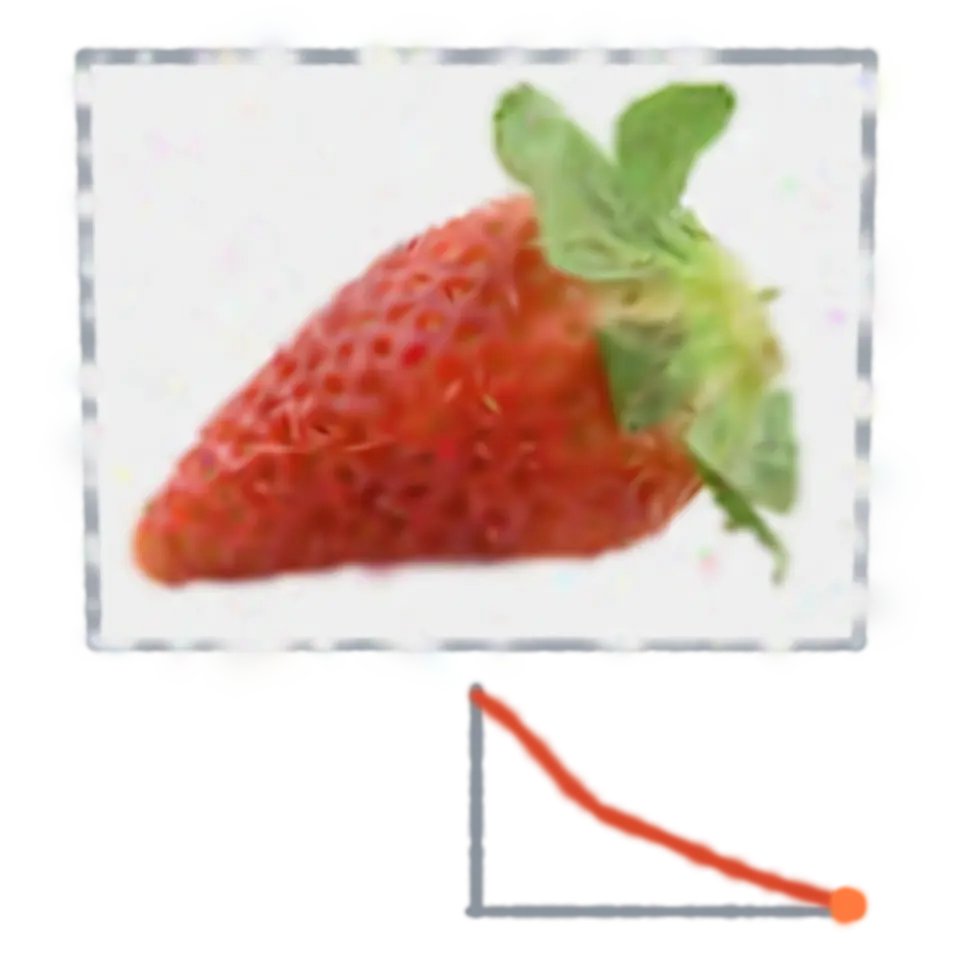
Tap it: a cloud of random splats slides, stretches and recolors into the strawberry photo, a real fit of 2,400 splats, while its error falls on the chart. Other views show one splat with its three axes, which a tap trains: it starts from a wrong guess and gradient steps move its place, turn, sizes, color and opacity toward the target outline, big steps first and then smaller ones, as in a real fit; a duck whose splats shrink to dots, and the back-to-front order splats are drawn in.
Is it right?
The photo view uses a real optimizer on 2,400 flat Gaussians, with checked compositing and loss derivatives. It is a single-image 2D fit, not a multi-view 3D reconstruction. The one-splat motion is prepared, and the sorting view has a reproducible distance-versus-depth error.
Correct
A photo is fit using 2,400 optimized Gaussians.12
The production fit count is 2,400. Independent pixel compositing agrees with the loss; finite differences agree with all 18 tested derivatives, and a small fit reduces its loss.
Simplified
The training picture is a single-image 2D version of Gaussian fitting.12
It optimizes position, two sizes, angle, color, and opacity in a flat photo plane, using Adam and cached frames; it does not optimize full 3D covariance from multiple views.
Simplified
The one-splat view illustrates optimization with a prescribed path.31
A shared factor (1−rate) to the step count reduces every target-parameter error for 24 steps, then forces zero. There is no rendered-image loss calculation in this view.
Being fixed
The sorting view shows the renderer’s back-to-front order.4
The bead order is sorted by Euclidean distance to a fixed camera rather than view-axis depth. The test finds pairs whose order disagrees with depth.
- 13D Gaussian Splatting for Real-Time Radiance Field Rendering, Kerbl, Kopanas, Leimkühler, and Drettakis, Inria
- 2Adam: A Method for Stochastic Optimization, Kingma and Ba
- 3Gradient descent, Dive into Deep Learning authors
- 4Gaussian rasterizer depth, Kerbl and coauthors, official implementation
- Simplified
- The photo fit uses a reduced-resolution image and 2D parameters, caches its optimization, and replays keyframes. It does not infer a 3D scene from several cameras or adapt the splat count. The one-splat path follows prescribed parameter-error decay and snaps to the target at the end.
Sources and credits
| Work | By | License |
|---|---|---|
| Strawberry on white background (the photo the splats learn) | Joselodos | CC0 1.0 |