Periodic Table
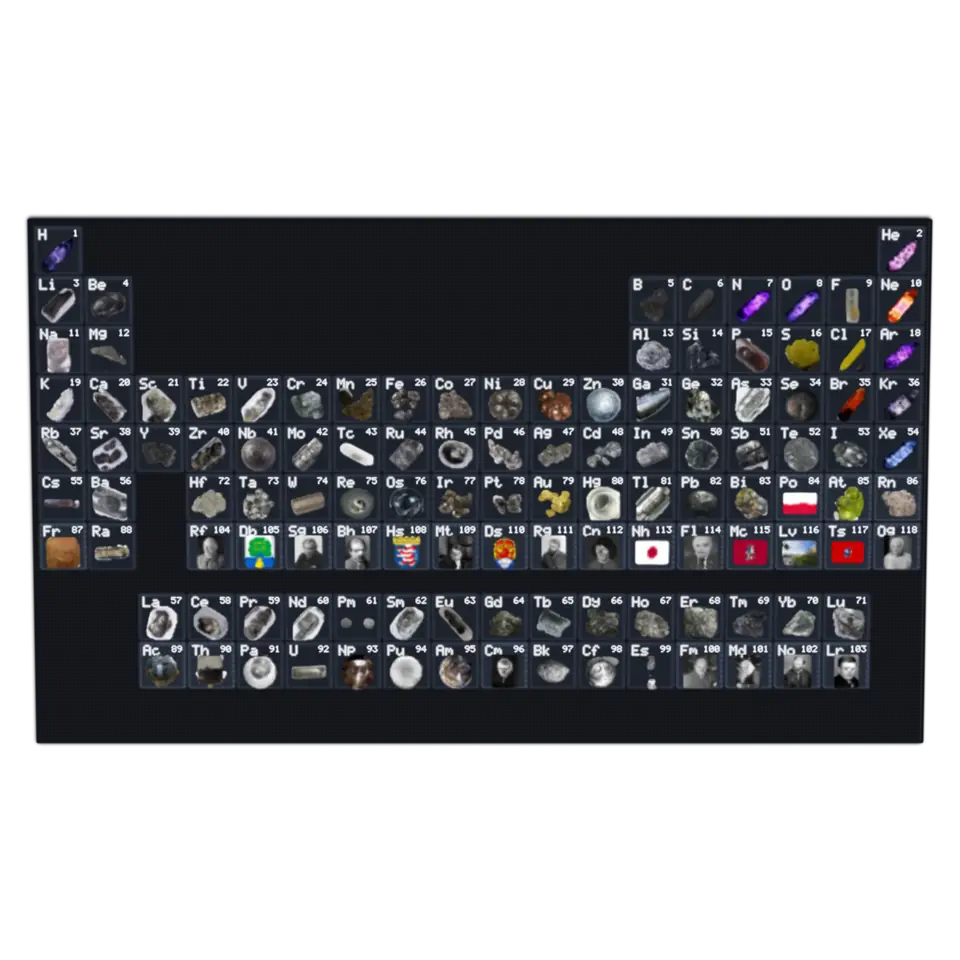
Every element as a real sample: lumps of metal, crystals, liquids and glowing gases in sealed glass.
- Lane
- 7, Atoms
- Kind
- Built from a recipe
- Sound
- Yes
- Licenses
- CC BY 3.0, CC BY-SA 3.0, CC BY-SA 4.0, Public domain, CC BY 2.0, CC BY 4.0, CC0
How to play
Tap a tile to lift its sample and facts; tap the sample to turn it, its tile to set it back.
Its controls
| Control | Kind | Range | Start |
|---|---|---|---|
| Lift or lower the sample | Tap | ||
| Lift the sample | Switch | Off | |
| Turn it around | Button | ||
| Element | List | 118 choices | 29 Copper |
| Tile colors | List | 3 choices | Plain (the samples' own colors) |
| Show info | Setting |
About it
Every element as a real sample: lumps of metal, crystals, liquids and glowing gases in sealed glass. Each sample is an open photo of the real thing, cut out and raised in 3D by a depth model. The front is real; the depth is an estimate, and the back of a lifted sample is made up from its own colors.
Tap a tile and its sample lifts out and turns toward you, with its facts from PubChem beside the stage, even in full screen (Show info hides them). Tap the sample to turn it, or its tile to set it back. 26 elements have no photo of a real sample, as the heaviest exist only a few atoms at a time; their hatched tiles show a stand-in. Photos: Images of Elements (CC BY 3.0) and Wikimedia Commons.
Details
- Splats
- Opens at 200,000 at Mid Detail, 93,324 at Low, and up to 568,368 at Max
Is it right?
The splash shows each element's facts (atomic mass, group and period, state at room temperature, density, melting and boiling points, discovery and one or two uses) and, for 92 elements, a photo of a real sample raised in 3D. The facts are PubChem's, copied by a build tool and checked against a saved copy of PubChem's table for all 118 elements; each use is our own short sentence backed by the words of Jefferson Lab or Los Alamos National Laboratory as PubChem quotes them. The samples' fronts are real photos; their depth is a depth model's estimate and their backs are invented.
Correct
All 118 elements are in the standard 18-column layout, with the right atomic numbers, symbols and names.12
The facts table is written from PubChem's periodic table by tools/rel-facts.mjs; the tile places come from the period lengths (2, 8, 8, 18, 18, 32, 32), with the lanthanoids and actinoids in two rows below.
Correct
Atomic mass, state at room temperature, density, melting and boiling points, year of discovery and category are PubChem's values.34
Each value is copied from PubChem's table at build time; the test compares every one of them for all 118 elements with the saved snapshot (tools/rel-reference.json), and ten elements' values typed in by hand from their PubChem element pages.
Correct
Each use shown is a real use of the element.56
Every use is a short sentence of our own with an exact quote from the element's 'Uses' section on PubChem (from Jefferson Lab's 'It's Elemental' or Los Alamos National Laboratory's periodic table); the build stops if a quote is not in its source, and the test checks each quote against the saved source sentence.
Correct
Group and period follow the element's place in the table.2
The period is the row; the group is the column of the 18-column table. Lanthanoids and actinoids are shown as 'Lanthanoid' or 'Actinoid' with their period, not given a group number.
Correct
Each sample is a photo of the real element; an element with no such photo says why and shows a stand-in picture, said plainly to be one.7
92 photos of real samples (Images of Elements, CC BY 3.0; Wikimedia Commons, public domain, CC BY or CC BY-SA), each license read on its live page. 26 elements have none: the sources show only illustrations (polonium, astatine, radon, francium, mendelevium to lawrencium), the only photos found aren't openly licensed (actinium, thorium, curium), or no visible amount has ever been made (fermium and everything from rutherfordium on). Each of those shows a stand-in from Wikimedia Commons: the person, place or flag it is named for, or a mineral that holds traces of it; the facts list says 'Shown instead' before it.
- 1Periodic Table of Elements, PubChem (NCBI, U.S. National Library of Medicine)
- 2Periodic Table of the Elements, IUPAC
- 3PubChem periodic table (JSON), PubChem (NCBI)
- 4Iron, PubChem (NCBI)
- 5It's Elemental, Jefferson Lab, U.S. Department of Energy
- 6Periodic Table of Elements, Los Alamos National Laboratory, U.S. Department of Energy
- 7Images of Elements, Jumk.de Webprojects
- Simplified
- The 3D samples are photos given depth by a depth model (Depth Anything V2 Small), which judges from one photo how far away each part is: the front is the real photo, the depth an estimate, and the back of a lifted sample made up from its own colors, since no photo saw it.
- Simplified
- Samples are not to scale: each fills its tile, whether it is a 6 kg sphere (neptunium) or 1.7 micrograms (berkelium); the descriptions give the real sizes where the sources do.
- Simplified
- PubChem gives some values under special conditions: helium freezes only under pressure (the splash says so), arsenic sublimes at normal pressure (the splash says so), and carbon's listed melting point is for graphite under pressure.