Unit Cells
A crystal is one small box of atoms, its unit cell, repeated in every direction.
- Lane
- 7, Atoms
- Kind
- Built from a recipe
- Sound
- Yes
- Licenses
- CC0, Public domain
How to play
Tap to step from the unit cell to a block of cells, then to the bonds, and back.
Its controls
| Control | Kind | Range | Start |
|---|---|---|---|
| Next view: cell, block, bonds | Tap | ||
| Next view | Button | ||
| Crystal | List | 6 choices | Diamond (C) |
| Cells along each edge | Setting | ||
| Start with | List | 3 choices | The unit cell |
| Thermal motion | List | 3 choices | Off |
About it
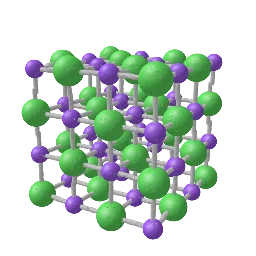
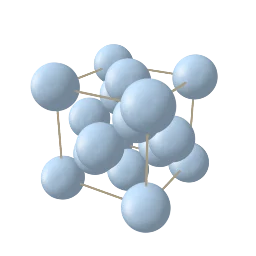
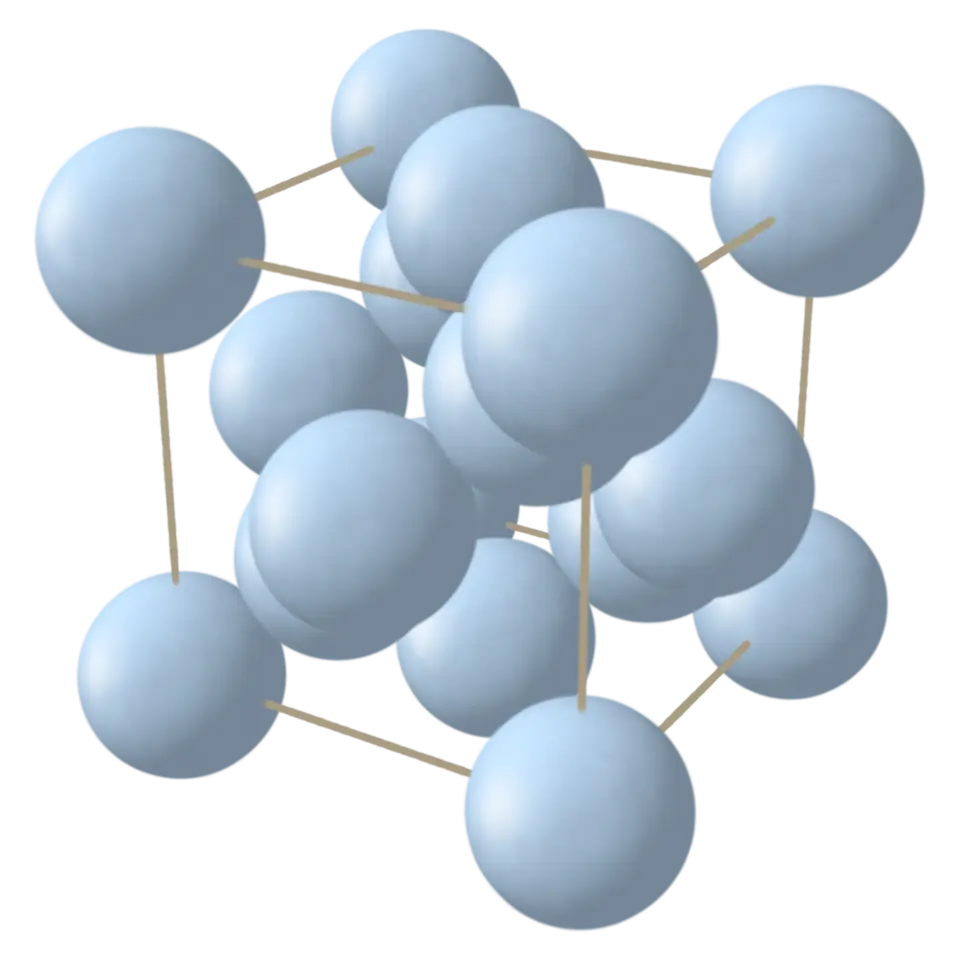
A crystal is one small box of atoms, its unit cell, repeated in every direction. This splash builds six real crystals from their measured cells: diamond, graphite, ice, and the metals copper (face-centered cubic), iron (body-centered cubic) and magnesium (hexagonal close-packed). The atoms are drawn to scale: in the metals, diamond and graphite, neighbors touch.
Tap to step from the unit cell to a block of cells, which grows out of it, and then to the bonds: each atom shrinks to a ball and sticks join its nearest neighbors (in the metals, atoms in contact). Choose the crystal, the cells along each edge and the first view. Thermal motion shows how far each atom's center wanders, from published measurements. Ice's hydrogens are one of the many arrangements real ice allows.
Details
- Splats
- Opens at 200,000 at Mid Detail, 119,884 at Low, and up to 999,640 at Max
Is it right?
The splash builds six crystals from their published cells and atom positions (Crystallography Open Database, public domain): diamond, graphite, ice Ih, copper (fcc), iron (bcc) and magnesium (hcp). Atoms are spheres with true relative radii, bonds join nearest neighbors at their real distances, ice's hydrogens obey the ice rules, and the optional thermal motion draws each atom as one Gaussian whose spread is its published mean-square displacement. Tests check the cells, the distances, the coordination numbers, the ice rules and the U values.
Correct
Each crystal's cell and atom positions are the published ones.123456
src/lattice/cells.js holds each cell (a, c, γ) and its basis in fractional coordinates as the COD entry gives them; blocks repeat the cell along its three axes.
Correct
Bonds join nearest neighbors at their real lengths: diamond 1.544 Å (4 each), graphite 1.423 Å in the layers (3 each), copper 2.556 Å (12), iron 2.482 Å (8), magnesium 3.21 and 3.20 Å (12).
findBonds joins atoms of the listed kinds whose distance is within a few hundredths of an ångström of the bond length computed from the cell.
Correct
Atoms have true relative radii: in the metals, diamond and graphite, neighbors touch (half the neighbor distance); in ice, the covalent radii of O (0.66 Å) and H (0.31 Å).7
Each crystal's radius table; the bonds view shrinks every atom by the same factor (2.5) about its own center.
Correct
Ice's hydrogens follow the ice rules: two on each oxygen, one on each O–O line, 1.00 Å from their oxygen.3
An Euler circuit on the periodic 6 × 6 × 6 network of oxygens (every oxygen has four neighbors) gives each O–O line's hydrogen to the oxygen the walk leaves from: each oxygen is left twice. Random turns give one of the many disordered arrangements of real ice. 1.00 Å is the distance from O1 to the file's H1 site.
Correct
Thermal motion: each atom's Gaussian has the published mean-square displacement, U = B / 8π², at 293 K for diamond and the metals, Trucano and Chen's anisotropic U for graphite, and the 81 K values for ice.89
One splat per atom whose sizes along x, y and z are √U (or 5√U when magnified): the Debye–Waller distribution of the atom's center, which is a Gaussian.
- 1COD 9008564: diamond, a = 3.56679 Å (Wyckoff, Crystal Structures, 1963), Crystallography Open Database
- 2COD 9011577: graphite (Trucano and Chen, Nature 258, 136, 1975), Crystallography Open Database
- 3COD 1538173: ice Ih (Goto, Hondoh and Mae, J. Chem. Phys. 93, 1412, 1990), Crystallography Open Database
- 4COD 9008468: copper, a = 3.61496 Å (Wyckoff 1963), Crystallography Open Database
- 5COD 9008536: α-iron at 298 K, a = 2.8665 Å (Wyckoff 1963), Crystallography Open Database
- 6COD 9008506: magnesium, a = 3.20927 Å, c = 5.21033 Å (Wyckoff 1963), Crystallography Open Database
- 7Covalent radii revisited (B. Cordero et al., Dalton Trans., 2832–2838, 2008), Royal Society of Chemistry
- 8Debye–Waller factors and absorptive scattering factors of elemental crystals (L.-M. Peng, G. Ren, S. L. Dudarev and M. J. Whelan, Acta Cryst. A52, 456–470, 1996), International Union of Crystallography
- 9COD 1572227: ice Ih at 81.15 K (IUCrJ 11, 2024), Crystallography Open Database
- Simplified
- The atoms are hard spheres; real electron clouds have no edge.
- Simplified
- The bonds view shrinks every atom by the same factor so the sticks show; the sticks between metal atoms mark neighbors in contact, not covalent bonds.
- Simplified
- Ice's hydrogens are one random arrangement allowed by the ice rules, repeating every six cells.
- Simplified
- In the thermal view, each Gaussian stands for where the atom's center is likely to be at an instant; the splash does not animate the vibration.
- Simplified
- The colors are chosen for each material, not measured.
Sources and credits
| Work | By | License |
|---|---|---|
| Crystallography Open Database entries 9008564, 9011577, 1538173, 9008468, 9008536 and 9008506 | the COD and the structures' authors (Wyckoff 1963; Trucano and Chen 1975; Goto, Hondoh and Mae 1990) | Public domain (CC0) |